Super-Efficient Perovskite Solar Cell Technology

«El sector energético se encuentra al borde de una nueva era, con las celdas solares de perovskita (PSC) emergiendo rápidamente como el sucesor más prometedor de las fotovoltaicas tradicionales basadas en silicio. Al ofrecer niveles de eficiencia revolucionarios, flexibilidad de diseño y unos costes de producción significativamente reducidos…»

Semiconductor Digest logo¿Te interesa saber más sobre el impacto que esta tecnología innovadora está teniendo en la industria de los semiconductores?

En su último artículo, «Tecnología de celdas solares de perovskita supereficientes: por qué la industria de semiconductores debería prestar atención», Thierry Grenut, director de ventas de Instrumentación Científica en Milexia France, comparte sus ideas como experto en la materia. El artículo se ha publicado en una de las principales revistas del sector, Semiconductor Digest.

Lee el artículo completo en las páginas 74‑75 aquí: https://magazine.semiconductordigest.com/html5/reader/production/default.aspx?pubname=&edid=de9f1b70-5ea1-44d1-b8e9-45c714185a13 

Powering Precision: Why the Future of High-Power Test Benches Must be Fully Integrated and Automated

“Los bancos de pruebas, antes considerados herramientas de apoyo, son ahora fundamentales para garantizar la fiabilidad, el rendimiento y la seguridad. A medida que aumentan las exigencias, el futuro de los bancos de pruebas de alta potencia pasa por una integración y automatización completas…”

Electronic Specifier Logo

Este extracto pertenece al reciente artículo de Jaafar Saied, director de ingeniería de campo de Pruebas y Medición en Milexia France, publicado en la revista Electronic Specifier Design Magazine, octubre de 2025.

En su artículo, ‘Powering Precision: Why the Future of High-Power Test Benches Must be Fully Integrated and Automated’, analiza cómo la integración total y la automatización están transformando esta tecnología innovadora, así como las implicaciones para aplicaciones como aeroespacial, defensa, energía nuclear y otras.

Leer el artículo completo aquí.

Powering Precision: Why the Future of High-Power Test Benches Must be Fully Integrated and Automated

“Los bancos de pruebas, antes considerados herramientas de apoyo, son ahora fundamentales para garantizar la fiabilidad, el rendimiento y la seguridad. A medida que aumentan las exigencias, el futuro de los bancos de pruebas de alta potencia pasa por una integración y automatización completas…”

Electronic Specifier Logo

Este extracto pertenece al reciente artículo de Jaafar Saied, director de ingeniería de campo de Pruebas y Medición en Milexia France, publicado en la revista Electronic Specifier Design Magazine, octubre de 2025.

En su artículo, ‘Powering Precision: Why the Future of High-Power Test Benches Must be Fully Integrated and Automated’, analiza cómo la integración total y la automatización están transformando esta tecnología innovadora, así como las implicaciones para aplicaciones como aeroespacial, defensa, energía nuclear y otras.

Leer el artículo completo aquí.

Powering Precision: Why the Future of High-Power Test Benches Must be Fully Integrated and Automated

“Los bancos de pruebas, antes considerados herramientas de apoyo, son ahora fundamentales para garantizar la fiabilidad, el rendimiento y la seguridad. A medida que aumentan las exigencias, el futuro de los bancos de pruebas de alta potencia pasa por una integración y automatización completas…”

Electronic Specifier Logo

Este extracto pertenece al reciente artículo de Jaafar Saied, director de ingeniería de campo de Pruebas y Medición en Milexia France, publicado en la revista Electronic Specifier Design Magazine, octubre de 2025.

En su artículo, ‘Powering Precision: Why the Future of High-Power Test Benches Must be Fully Integrated and Automated’, analiza cómo la integración total y la automatización están transformando esta tecnología innovadora, así como las implicaciones para aplicaciones como aeroespacial, defensa, energía nuclear y otras.

Leer el artículo completo aquí.

Precisión de Potencia: Por qué el futuro de los bancos de pruebas de alta potencia debe ser totalmente integrado y automatizado.

“Los bancos de pruebas, antes considerados herramientas de apoyo, son ahora fundamentales para garantizar la fiabilidad, el rendimiento y la seguridad. A medida que aumentan las exigencias, el futuro de los bancos de pruebas de alta potencia pasa por una integración y automatización completas…”

Electronic Specifier Logo

Este extracto pertenece al reciente artículo de Jaafar Saied, director de ingeniería de campo de Pruebas y Medición en Milexia France, publicado en la revista Electronic Specifier Design Magazine, octubre de 2025.

En su artículo, ‘Powering Precision: Why the Future of High-Power Test Benches Must be Fully Integrated and Automated’, analiza cómo la integración total y la automatización están transformando esta tecnología innovadora, así como las implicaciones para aplicaciones como aeroespacial, defensa, energía nuclear y otras.

Leer el artículo completo aquí.

Powering Precision: Why the Future of High-Power Test Benches Must be Fully Integrated and Automated

“Los bancos de pruebas, antes considerados herramientas de apoyo, son ahora fundamentales para garantizar la fiabilidad, el rendimiento y la seguridad. A medida que aumentan las exigencias, el futuro de los bancos de pruebas de alta potencia pasa por una integración y automatización completas…”

Electronic Specifier Logo

Este extracto pertenece al reciente artículo de Jaafar Saied, director de ingeniería de campo de Pruebas y Medición en Milexia France, publicado en la revista Electronic Specifier Design Magazine, octubre de 2025.

En su artículo, ‘Powering Precision: Why the Future of High-Power Test Benches Must be Fully Integrated and Automated’, analiza cómo la integración total y la automatización están transformando esta tecnología innovadora, así como las implicaciones para aplicaciones como aeroespacial, defensa, energía nuclear y otras.

Leer el artículo completo aquí.

Harogic/Versys announces strategic partnership with Milexia to expand European market presence

Harogic/Versys announced today a strategic partnership with Milexia, a prominent European distributor with an extensive network across France, Italy, Spain, UK, Germany and the Nordics region.

Under this new agreement, Milexia will be responsible for the sales, distribution and support of Harogic Technologies’ full range of innovative spectrum analysers throughout these designated regions.

With Europe being one of the fastest growing markets for spectrum analysis and wireless technology, this partnership with enable Harogic to strengthen its global footprint while offering customers in Europe access to cutting-edge solutions with localised service and support.

“We are incredibly excited about this partnership with Milexia,” said Lucas Lu, Sales Director for Harogic Europe. “Their strong presence in Europe will bring our high-quality spectrum analysers to a broader audience.” Milexia has also expressed high expectations for its collaboration with Harogic and believes their clients will benefit from it.

Franck Guglielmazzi, President at Versys, said: “The incredible success we’ve seen in France has proven the immense potential of Harogic. This collaboration is a new and exciting chapter that will allow us to export our proven model. We couldn’t ask for a better partner than Milexia to help us navigate this significant expansion.”

Virginie Laurent, Milexia Group Sales and Marketing Director, commented: “Milexia is dedicated to delivery access to state-of-the-art, high performance and competitive technologies to its customers. We are proud to launch our new RF Test & Measurement solutions, designed to deliver seamless integration and superior performance. Harogic’s innovative produce range complements our portfolio perfectly, enabling us to harness our extensive European network and market expertise to further enhance Harogic’s global reach, thereby engaging an even broader spectrum of European enterprises. Our sales teams are thoroughly prepared and poised to actively pursue new opportunities and delve into emerging markets.”

The partnership is effective immediately, and both companies are dedicated to working closely to ensure a seamless integration and a successful long-term relationship.

About Harogic:
Hardware + Logic = Harogic

Harogic Technologies combined compact, high-performance RF hardware with agile, intelligent software to help our global customers extend RF boundaries. Harogic delivers innovative, flexible spectrum analysers up to 40 GHz that empower engineers, researchers and developers to create their own RF systems.

About Milexia:
Founded in 1971, Milexia Group is one of the world’s leading European suppliers for high-quaity electronic components, systems and scientific instruments technology. It has offices and warehouses in France, Italy, Spain, the United Kingdom, Germany and Nordics. The Group has technical centres in France and the United Kingdom, which offer customised engineering services, installation, training and maintenance solutions for defence, space, transportation, satcom, scientific instrumentation and other civil industries.

Engineering the future of defense systems: A V-model approach to custom embedded solutions

Military Embedded Systems logo“In modern military operations, embedded computing platforms must deliver uncompromised performance, withstand extreme environmental stress, and seamlessly interface with complex electronic subsystems” 

This extract is from a recent article by Laure El Mhadder, our Sales Director for Milexia France, on ‘Engineering the future of defense systems: A V-model approach to custom embedded solutions’. An article which explores the unique benefits that this particular model offers for the defense sector, and even a case study by Milexia on a real-world application of the model.

Read more in Military Embedded Systems, here.

Discover Milexia’s range of cutting-edge technologies from our Partners

We’re delighted to announce that our Partner Holkirk will be bringing their latest innovations in satellite communications to this year’s International Broadcasting Convention (IBC)!

This is one of the biggest global events for the broadcasting industry, showcasing the latest technological advancements.

In this article, we’re giving a sneak peek at the innovative solutions that Holkirk will be bringing to the convention, where you can meet their experts and discuss their potential application to your projects in more depth…

SCARAB Ku-Band – Satellite terminal

The auto-pointing SCARAB terminal helps users establish reliable connectivity for remote operations including live newsgathering and broadcasting. The terminal supports X, Ku and Ka frequency bands, featuring a unique cartridge system that allows users to quickly change between bands without tools or technical expertise.

Multi-Orbit Mastery & Auto-Pointing Precision

Optimised for Geostationary Orbit (GEO), Medium Earth Orbit (MEO), Highly Elliptical Orbit (HEO) and inclined orbit satellites, the SCARAB features an OpenAMIP compatible ACU that automatically locates the desired satellite, providing a stable connection for broadcasters.

Instant Multi-Band Power

Experience lightning-fast, tool-free swaps between Ku-Band and Ka-Band with Holkirk’s revolutionary quick-change head. Enabling you to adapt to any network, anywhere, in a matter of minutes.

Auto-Pointing Precision

Get on-air faster with fully automatic satellite acquisition. The OpenAMIP compatible ACU and seamlessly integrates with legacy FSS, and recent HTS multi-beam GEO satelllites. Ensuring optimal performance, every time.

Uninterrupted Operations

Power through your critical broadcasts with the integrated, hot-swappable Lithium-Ion battery, offering 2-3 hours of continuous operation, with flexible DC powering options for extended missions.

Extreme Portability

Designed for ultimate mobility, the SCARAB splits into two rugged, man-portable cases (approx. 14kg & 23kg), making it perfect for rapid deployment in the most demanding environments.

Scorpion-Lite – Lightweight satellite terminal

The Scorpion-Lite features everything you need for reliable data and voice in a satellite communication terminal, packed into a single, IATA-compliant case, light enough to be a simple carry-on for a flight. Thus, making it essential for news crews who needs to establish a robust link fast without logistical hurdles.

From Case to Connection in Minutes

In the field, time is always crucial. The Scorpion-Lite was built for rapid deployment with no tools, no complicated manuals, and no endless parts. With just seven rugged, easy-to-assemble components, you can go from packed case to fully operational in minutes. It’s designed for simplicity and speed, exactly when you need it most.

Intelligent Pointing, Global Reach, Effortless Operation

The Scorpion-Lite features an innovative onboard Manual Pointing Assistant Instructor (MPAD3), designed to make satellite pointing simple and intuitive. It’s more than just a basic compass –  it’s a smart, integrated guide that walks you through the pointing process with step-by-step instructions on a high-visibility, ultra-bright display. The result: fast, accurate satellite acquisition with minimal effort.

Certifications and protocols

The Scorpion-Lite is fully certified on INTELSAT Flex and SES SKALA platforms. Thus, making it a true global player for high-speed, reliable broadband. With Satcom as a Managed Service (SaaMS) support and OpenAMIP protocols, the MPAD3 will even instruct you on the best satellite to use and then how to get connected. Giving you a satellite expert on the ground with you.

RM150 DSNG – Antenna

The Holkirk RM150 is a state-of-the-art Digital Satellite News Gathering (DSNG) system that has been fully characterised by Eutelsat. This stamp of approval means it meets the highest standards for performance and reliability in satellite news gathering. With its 1.5m high-gain carbon fibre reflector, the RM150 ensures exceptional signal quality, even in the most challenging environments.

Their RM series of antennas are built with meticulous attention to mechanical detail and feature high-performing materials, guaranteeing many years of continuous service in the harshest applications. When your news demands to be heard, the RM150 delivers. Making it an investment in efficiency, longevity, and simplified operations for your DSNG fleet.

GaN Technology – Amplifiers

The landscape of DSNG is rapidly evolving, and over the next 5-10 years embracing new technologies will be crucial. Hence, why Holkirk is championing the integration of Gallium Nitride (GaN) technology into their customers’ uplink strategy.

Lower Cost

On average, a comparable GaN Solid State Power Amplifier (SSPA) can be 25% less expensive than a TWT. With rising tube replacement costs and extended wait times for service, replacing a TWT amplifier with a GaN equivalent can be a significantly more cost-effective option.

Lighter Weight & Smaller Size

GaN transistors operate at high voltages and currents without overheating. This allows for smaller overall packaging, resulting in a reduced footprint and lighter weight for equivalent power levels. And less bulk means more mobility for your crew.

Less Power Consumption

GaN amplifiers draw current proportionally to the output power, meaning they are incredibly efficient, especially at lower output levels. This translates to significant power savings in the field.

Longer Lifespan & Easier Maintenance

Unlike TWTs which rely on a limited-life cathode, GaN amplifiers use a robust semiconductor material. This means longer operational lifespans and virtually maintenance-free operation compared to the delicate processes required for TWTs. With no heater warm-up times and no cool-down procedures, just turn on and go.

TP120: The Trusted Workhorse of DSNG

Milexia and Holkirk are proud to spotlight a true legend in satellite news gathering: the TP120. And we’re excited to confirm that this trusted workhorse of DSNG will be returning for IBC 2025.


Enensys’ IPGuardX Real-time Failover Switching product

In this article, we explore some of these benefits, as well as the potential to see a live demonstration of this technology…

Overview of IPGuardX features and benefits

IPGuardX prevents network failures that culminate in loss of service for end users, by monitoring inputs and detecting possible loss of service. Using intelligent and automatic switching to maintain stream availabilities on the network.

Some of the key benefits of IPGuardX include:

  • In-built flexibility to suit a range of different requirements.
  • Scalability to match changing demand of your operations.
  • No service loss, ensuring a 100% reliable network for your operations.
  • Future proofing, guaranteeing a solution for the long-term.
  • Ease of use and installation.
  • Extensive experience in this technology and its requirements.

Guaranteeing reliable performance

IPGuardX delivers the ultimate user experience, avoiding loss of service and limiting impairment.

IPGuardX secures IP and Transport Stream over IP (TSoIP) streams and automatically, seamlessly switches when a failure or degradation is detected (this can be performed automatically or manually). The automatic changeover provides clean uninterrupted switching, without packet loss and no visible artifacts on the screen.

By utilising a bypass facility provided through dedicated failover network cards, it guarantees 100% service availability. In addition, it is also fully scalable, providing redundancy for a minimal or large number (from 1 up to 250) of streams on a pay-as-your-grow basis.

At the same time, a user-friendly Graphical User Interface (GUI) enables an easy and flexible system setup.

Customising to your operational needs

IPGuardX can be deployed on-prem or in public/private clouds with SRT I/O. Moreover, switching can be controlled at the stream or network level, thereby protecting operators Service Level Agreements (SLAs). This Two-Level Redundancy Architecture monitors Network Redundancy and Stream Redundancy simultaneously.

Appliance based switching is also available by selecting the relevant criteria for the equipment to be switched on. This includes the protection of Encoders, Multiplexers, DTT Broadcast Gateways, Video on Demand (VOD) Servers, Content Delivery Networks (CDNs), IRDs, etc.

Finally, with over 12 years’ experience in providing automatic change-over switching, Enensys have designed IPGuardX with effective future proofing, by ensuring the software is developed with the latest technologies (Docker, SRT) for long-term customer benefit.

Meet us at the International Broadcasting Convention (IBC) 2025

Milexia UK is excited to announce it will be demoing IPGuardX at IBC 2025. Come visit us on Stand 1.A63 to see it for yourself!

The Milexia IPGuardX software-based product will be running on a COTS Server demonstrating ‘on-prem’ seamless switching. Our team members will also be there to answer any questions you may have on this technology.

Book a meeting with one of our experts here: https://milexia.com/event/join-milexia-at-ibc-2025

The modern technical requirements that need to be met for GNSS, LPN and PTP technologies.

For instance, it used to be that LPN (Low Phase Noise) references were once a luxury of satellite operators and engineers – and while it was nice to have, it was by no means a necessity.

A decade ago, PTP (Precision Time Protocol) was a cutting-edge development, but it’s now evolved into an industry standard in the form of SMPTE 2110. GNSS antennas, on the other hand, were installed to support the operation of precise timing, but these were often used without consideration of threats towards the antenna and how to mitigate against them.

In this article, we will discuss the current technical requirements for these technologies, how they are mandated in many future system designs, and how new solutions such as the SyncServer S650 can deliver on these with ease.

Low Phase Noise – LPN Technology

LPN references, that were once considered by many a luxury, have become the backbone of modern high reliability satcom systems.

When system performance fluctuates, one of the common sources of the problem is the system reference. Users and operators alike try to squeeze as much performance out of a connection to reduce the needs for higher bandwidth than they require.

However, the downside of this is as you reach the edges of the performance window, issues begin to occur. BER can start to increase to unacceptable levels, signal demodulation can degrade, and data rates can reduce below SLA requirements, all of which could be prevented.

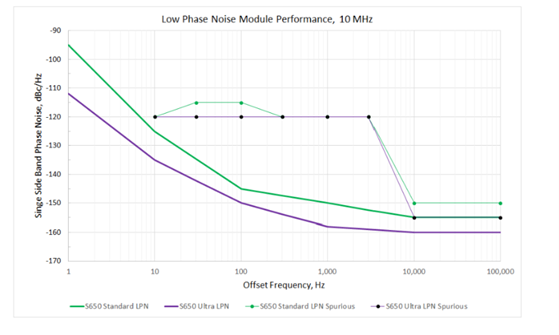
The chart below demonstrates the noticeable performance gains between system references of standard phase noise, low phase noise and ultra-low phase noise.

Low phase noise module performance

Precision Time Protocol – PTP Technology

SMPTE 2110 is both the today and the future of broadcast networks.

Of course, PTP generally is not all that new having been deployed in hundreds of thousands of systems globally. The benefit of this widespread use is that the satcom and broadcast industry can learn lessons from sectors such as financial services and telecoms, that are leveraging this technology in more reliable deployments.

PTP, while being a protocol, is a measurable protocol, in that the stability, accuracy and resiliency of the PTP source is a critical path to the fundamentals of stable operations. This can be demonstrated in the example below showing that not all PTP Sources are the same.

Ultimately, this means that even if a system provides a SMPTE 2110 reference, they should be verified, stressed and tested to ensure the peaks and demands of a growing network deployment can be withstood.

PTP sources

Operating System Protocol Synchronization Excursions
Linux (Intel 64-bit Kernel 2.6.30 or later) HW TS PTPv2x < 5 nanosecs Rare
Linux (Intel 64-bit Kernel 2.6.30 or later) HW TS NTP ~ 10 nanosecs Rare
Win10, Server 2012R2 / 2016 / 2019 PTPv2x ~ 1 µs Rare
Vista, Server 2008, Win7 PTPv2x < 100 µs Regular
Win10, Server 2012R2 / 2016 / 2019 NTP < 500 µs Occasional
Vista, Server 2008, Win7 NTP 1-100 ms Excessive


Global Navigation Satellite Systems – GNSS (GPS) Technology

Full unrestricted access to GPS was made available in the year 2000, and it changed the fundamental way in which precise time was delivered to users.

As a result, low-cost GPS receivers would replace expensive atomic clocks, leading to accuracy and flexibility improving dramatically, and with it everything generally getting a little bit easier.

As GNSS technology rose in use and popularity, systems and protocols advanced to ever greater levels of accuracy, thus underpinning the operation of so many broadcast and communication systems.

But, while the weaknesses of GPS were acknowledged as far back as 1983, they were never truly exposed or exploited until recent years. As of 2025 there has been significant body of evidence towards deliberate jamming and spoofing (manipulation) of GNSS signals, within both military and civilian spheres.

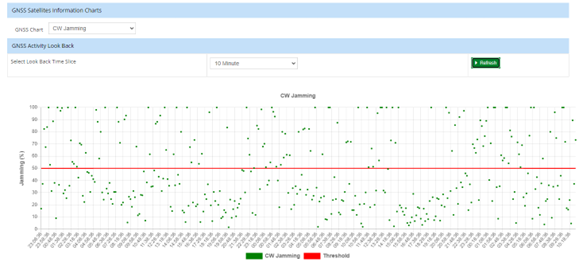
GNSS interference

It is clear from these findings that GNSS Systems can no longer operate with impunity, and thus without consideration, towards threats that they may face.

They must be consistently monitored for both jamming and spoofing. Both of which can cause significant operational headaches and ultimately denial, and/or loss of service, to their wider connected system.

Conveniently the Microchip SyncServer S650 has all three capabilities in one system, with Microchip being the market leader in timing systems for over 30 years. As well as having been deployed in some of the harshest, most challenging environments that could be imagined

Meet us at the International Broadcasting Convention (IBC) 2025

Milexia UK is excited to announce it will be exhibiting at IBC 2025 from 12-15 September. Come visit us on Stand 1.A63 and meet the team! We’ll be hand on hand to discuss the latest innovations in GNSS, LPN and PTP and how these technologies can transform your operations.

Book a meeting with one of our experts here: https://milexia.com/event/join-milexia-at-ibc-2025


Assured PNT: keeping critical operations on track

Global navigation satellite systems have become the invisible fabric that holds modern logistics, energy, defence and autonomous operations together.

Yet GNSS signals are weak by nature and are being increasingly exposed to deliberate jamming and spoofing. When the signal is denied, or manipulated, positioning and timing can drift in seconds – with costly or dangerous consequences.

Assured Positioning, Navigation and Timing (A‑PNT) remedies this risk: it delivers centimetre‑class accuracy while actively detecting and rejecting interference. The latest A‑PNT receivers integrate several layers of resilience:

  • AIM+ interference‑mitigation – proven in DHS and NATO jammer trials, it suppresses everything from narrow‑band noise to complex pulsed attacks.
  • Multi‑layer anti‑spoofing with signal‑anomaly monitoring and cryptographic authentication (e.g., Galileo OSNMA).
  • Real‑time RF situational awareness – built‑in spectrum plots and threat flags give operators instant feedback on jamming direction and severity.

Flexible form factors – compact OEM modules, ruggedised IP68 boxes, single‑ or dual‑antenna GNSS, and GNSS/INS hybrids to suit every platform.

Where A‑PNT makes the difference

  • Tactical radios, C4ISR nodes and autonomous vehicles operating in NAVWAR zones
  • Timing distribution for power grids, telecom and financial networks
  • Survey and robotics working near heavy machinery or reflective structures

Milexia’s added value

As Septentrio’s distribution partner, Milexia bridges world‑class A‑PNT technology with local integration expertise:

  • Application engineering – selecting the optimum receiver, antenna and correction service for your SWaP‑C envelope.
  • Rapid prototyping – evaluation kits, antennas and cabling from stock to accelerate design cycles.
  • Lifecycle support – from pre‑sale testing to field deployment, with secure firmware‑update management.

Whether you need to harden an existing platform or design a new autonomous system from scratch, Milexia delivers the assured PNT building blocks that keep missions on course – even when the RF environment is working against you.

Find out more about our products here.

Let’s discuss with the Milexia Team how Assured PNT can secure your next project.